
 Ask the Production PandaGet in touch
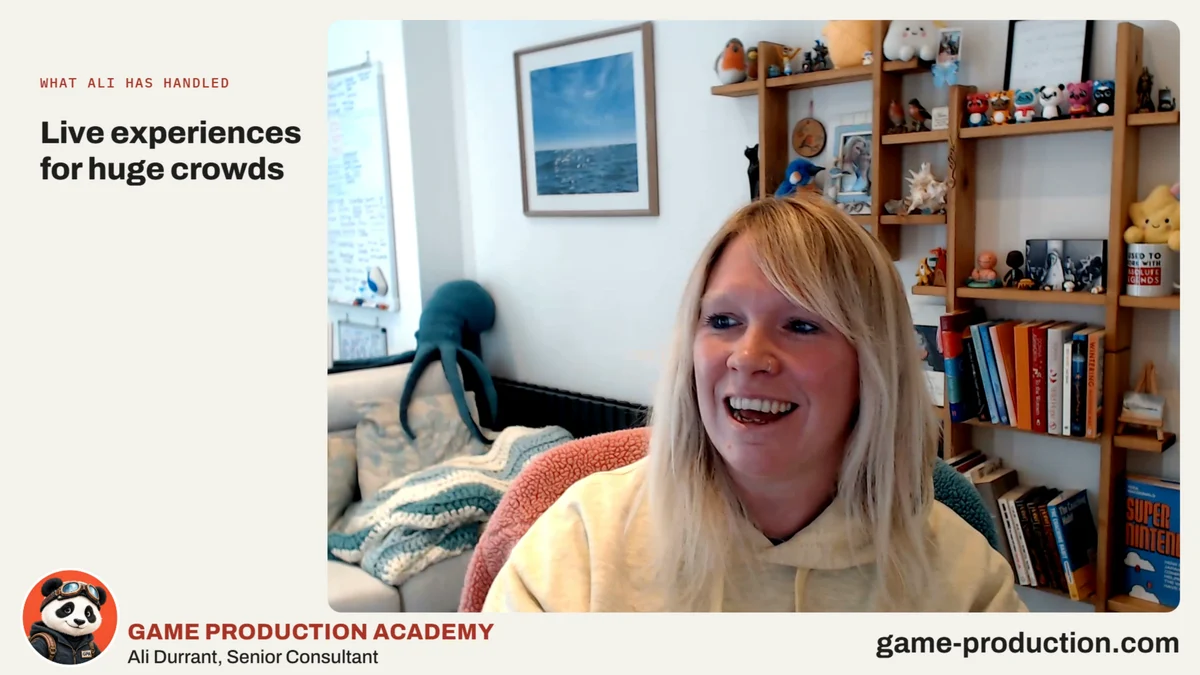
I’ve asked Ali Durrant to join me at Game Production Academy. This is something I’m very pleased about, although having known her for quite a few years I suspect she’ll tell me when I’m talking rubbish. Which is probably no bad thing.
We first met when we were working on PlayStation Home. I was on the development side and Ali worked across development and the rather complicated business of looking after developers producing content for the platform. We later ended up working together again at nDreams, where she was a programme director working across studios.
So we know each other pretty well. And, given that we’re both producers, we’ve accumulated a fair number of opinions about how games should be made and how the people making them ought to be treated.
We’ve recorded our first conversation for the Academy. The idea was to introduce Ali, explain a bit about her background and give people an idea of the subjects we’ll be discussing together. We managed that, although it didn’t take long before we were off talking about one of my favourite questions.
What does a game producer actually do?
A job that can be surprisingly difficult to explain
One of the stories Ali told made me smile. When she was working at PlayStation, an artist who was a good friend of hers told her that he liked her very much, but had absolutely no idea what she did.
I have heard versions of that question many times, and I think it is a fair one.
I’ve met developers who think producers are simply there to organise meetings, ask for updates and move things around in Jira. Sometimes, unfortunately, that’s more or less what they’ve experienced. We ought to be able to admit that rather than getting defensive about it.
Ali’s answer to her friend was interesting. She asked him whether he knew what he was working on that week, what his responsibilities were, whether he understood the milestones, whether the team had what it needed and so on. He did, of course. Her point was that somebody had been doing quite a lot of work behind the scenes to make those answers possible.
I don’t think that explanation covers everything a producer does, and neither does Ali. But it reminds us that good production can be rather difficult to see. People notice a broken process, a late decision or an impossible commitment. They don’t always notice the person who helped prevent those things in the first place.
There is a trap here as well. If we describe good production entirely as invisible, helpful activity, we can accidentally make it sound as though the producer is everybody’s administrator. That’s not good enough either.
I would rather be able to say what decisions have become easier, what dependencies are being managed properly and how a team is better able to concentrate on making the game. If the producer is only recording everybody else’s progress, we should probably ask whether we are making proper use of the role.
You can teach the tools. The conversations are harder.
Ali has had a remarkably varied career. She began in QA and moved into project management and production, then worked on projects including PlayStation Home and live esports experiences with Riot Games. She has also worked at senior level across several studios.
It was interesting hearing her describe how differently companies teach production. Some train people very deliberately. In other places, producers learn by being thrown into whatever is happening that week and working out how to survive it.
I’ve spent a lot of time thinking about production systems, risk management and how studios can get a better understanding of what is actually happening. I think these things are important. A producer needs somewhere to put a risk, to record a decision and to see what one team is waiting for from another. Otherwise we end up making everything dependent on who remembers which conversation.
But that only gets us so far.
Imagine that an external partner keeps sending back work that doesn’t meet the quality you’ve agreed. The task board can tell you that the work has been rejected. It might even give you a very impressive red report.
Now what?
Somebody still has to speak to the partner, understand what has gone wrong, decide whether the brief was clear in the first place and work out what to do about the time and money involved. There may be difficult people in the room, quite possibly including us.
That’s the area Ali is particularly keen to help people with: the experience and judgement needed when a tool has given you the information but can’t tell you how to handle the situation.
I don’t want to reduce this to me knowing systems and Ali knowing people. We’ve both spent years dealing with both. What I like is that we approach the same problems from rather different directions, and we can test each other’s thinking.
The producer who fixes everything
Another part of our conversation struck me because I suspect a lot of producers will recognise it.
Ali talked about being something of an emergency producer earlier in her career. She would arrive in a difficult situation, establish trust and get things moving. It’s a useful skill, and when something is on fire people are understandably delighted to find somebody willing to help.
But there is a point at which helping becomes doing everybody else’s work.
Ali described how she learnt to recognise when she was taking on too much and to step back. If the producer always absorbs every awkward decision, every problem and every bit of extra work, what happens to the people who should be responsible for those things? And what happens when that producer is away, or simply can’t take any more?
I don’t think the answer is to stop helping people. Quite the opposite. The question is whether you’re helping the team become more capable or making the team dependent on your ability to rescue it.
There are times when you absolutely have to get involved and push something through. There are other times when the most useful thing you can do is help the right person make the decision, and then leave the work with them.
Getting that judgement right is part of the job.
Can producers be creative?
Towards the end we had a discussion that I suspect will generate a few opinions.
I’ve worked with producers who assumed that because they were responsible for delivery, they were also entitled to tell a designer, artist or engineer exactly how the game should be made. I have never been very comfortable with that, unless the producer has specifically been given that authority.
Ali immediately reminded me of the other side of the argument. She’s worked in places where she was told, very plainly, that nobody wanted her creative opinions because she was the producer. Having chosen a production career doesn’t mean somebody stops having ideas about games. And in some roles, including a creative producer, the authority really does include creative work.
I think we reached a sensible distinction.
You ought to be able to contribute an idea, question something that looks wrong or help somebody see a problem differently, regardless of your job title. But contributing to a creative discussion and being the person authorised to make the creative decision are two different things.
That may sound obvious when written down. It can become considerably less obvious when there are strong personalities in a room and a milestone approaching.
Why Ali is joining the Academy
When I started Game Production Academy it was mainly a way of sharing things I’d learnt and making practical material available to producers. It has developed into courses, mentoring, consulting and rather a lot of discussions about the strange and often difficult business of making games.
Adding Ali gives us another experienced person with her own opinions, examples and ways of helping. It also gives me somebody to have these conversations with, which is a great improvement on talking to myself.
I don’t intend to make great promises here about a hundred new courses or a wonderful new production philosophy. I’d much rather we start with useful discussions, see what people want help with and make something worthwhile from that.
If you’ve ever had to explain to somebody what a producer actually contributes, or found yourself doing work that ought to belong to somebody else, I think you’ll enjoy this first conversation.
Watch our conversation: YouTube
Or listen to the podcast: Buzzsprout
You can also read more about us and the Academy.