Identify what could go wrong
Recognise risks across the game lifecycle, from concept and pre-production to release and LiveOps.

 Ask the Production PandaGet in touch
Individual course · Game-production practice
Learn to spot risks while there is still time to do something about them, and to explain them so that someone actually does.
This is the foundation course. It starts with a single project and works up to how the same risks look across a programme and a whole portfolio.
Who it is for
It suits producers, project managers, team leads and delivery or operations leads. Indie founders and students heading into the industry will get a lot from it too.
When scope shifts, a key dependency slips or someone leaves, the schedule tells you something has moved. It does not tell you how exposed you now are or what to do next. That is what this course teaches.
What you will learn
Recognise risks across the game lifecycle, from concept and pre-production to release and LiveOps.
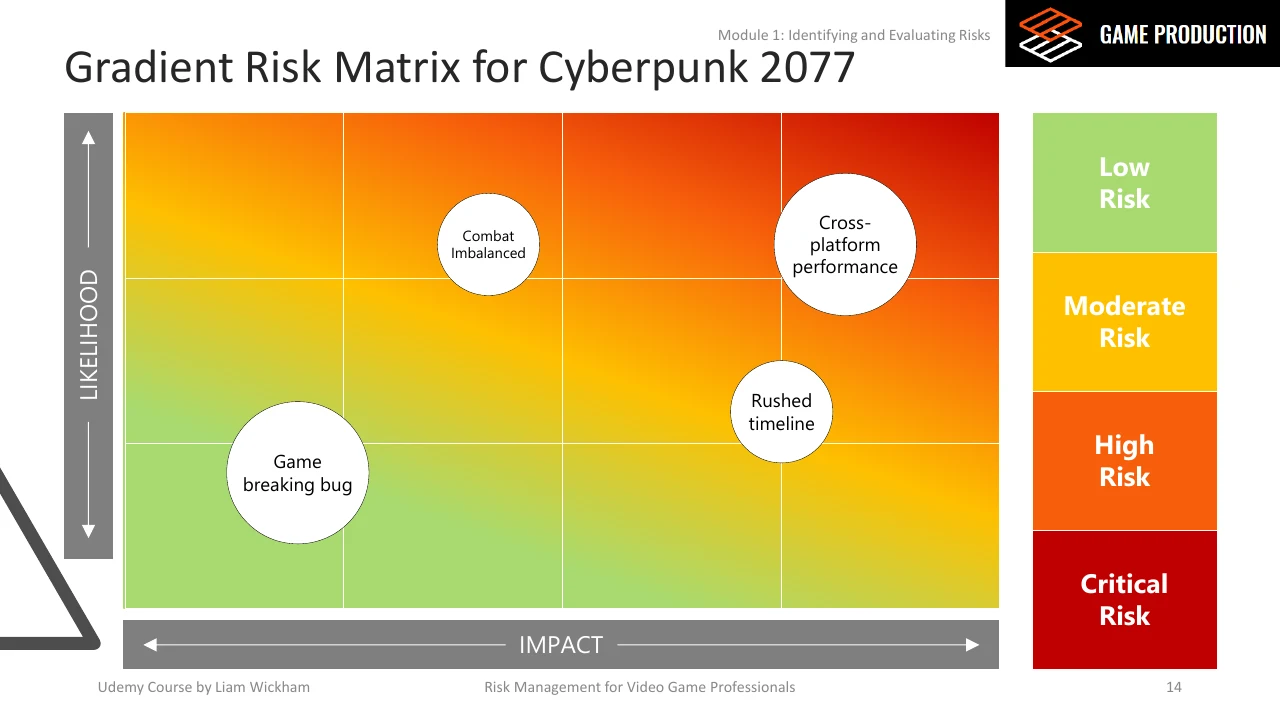
Use likelihood, impact and a risk map to decide where your attention goes first.
Choose how to respond, track the actions and keep a risk register people actually read.
Explain risk at project, programme and portfolio level, in reports that help someone decide.
Inside the course
Staffing, budget, specification, change and external partners are part of the course, not footnotes to a generic project-management model.
You work through risk matrices, register walkthroughs and production scenarios, so the assessment leads somewhere: a mitigation, an escalation or a conversation with the right person.
14 chapters · 84 lessons
You learn the basics and practise responding. Then you see how the same risk changes as a game moves through its lifecycle, and how it looks from project, programme and portfolio level.
Chapters 01–03
Foundations, terminology and how to identify and evaluate risk, using staffing, schedule, budget, scope, change and external partnerships as the main areas.
Chapters 04–06
Work through implementation stages, Miro examples, mitigation strategies and tracking actions in Agile and Lean production.
Chapters 07–09
Risk registers, RAID logs, stakeholder reports and risk meetings, and how to make them part of a team culture where people raise problems early.
Chapters 10–12
Crisis scenarios and lessons learned, followed by risks from concept through pre-production, alpha, beta, release and post-release.
Chapters 13–14
Project, programme and portfolio perspectives, their connections, a Kanbanize illustration, course summary and certificate.
Learner perspectives
This course had an earlier life on Udemy. The comments below come from our older testimonial collection, including that period, and are separate from the current Thinkific reviews.
5 out of 5 stars from this learner.
“The content is well-structured, practical, and highly relevant to real-world production scenarios. A must for anyone working in game production.”
5 out of 5 stars from this learner.
“A fantastic course which delves into depths of Risk Management with resources, examples and stages.”
5 out of 5 stars from this learner.
“Liam's ability to break down complex concepts into easy-to-understand terms, coupled with real-world examples, made the learning experience enjoyable.”
5 out of 5 stars from this learner.
“It contains information that is relevant not only to production but to every single role in the industry.”
5 out of 5 stars from this learner.
“As a co-founder of an indie studio I wish I had this knowledge while in pre-productions.”
5 out of 5 stars from this learner.
“Very clear, detailed and relevant explanations, engaging delivery and practical examples.”
Your next step
The self-paced course is £249. You enrol and take it on Thinkific.
If you want to try a few lessons first, the free preview lets you do that before you pay. Thinkific handles your account and payment.
Before you buy or book, read our terms, cancellations and refunds and privacy notice. Buying or enrolling does not subscribe you to the newsletter.