
 Ask the Production PandaGet in touch
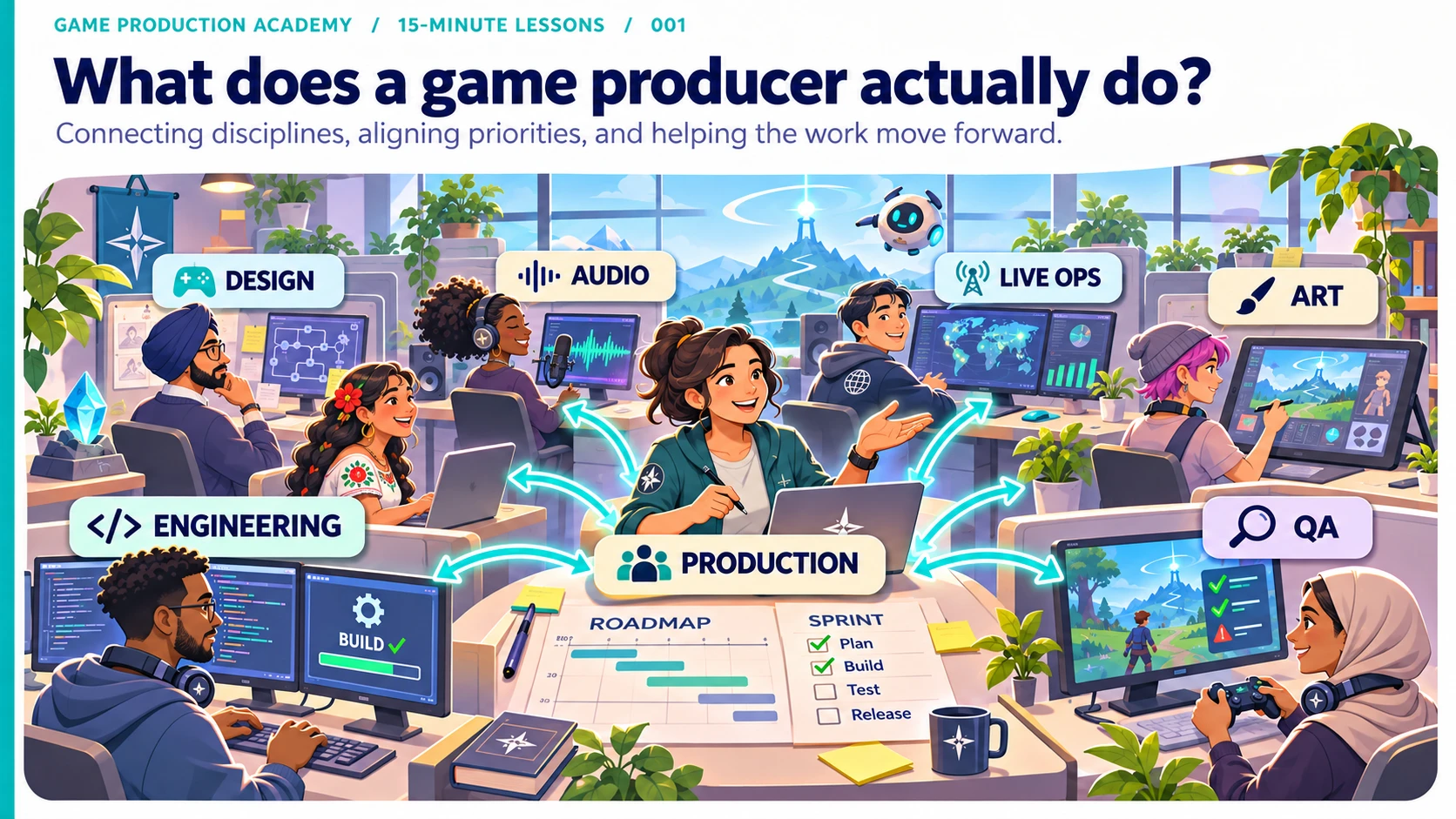
A lot of people will tell you that a good game producer is someone who listens to people, helps them resolve their problems and is particularly good at bringing people together. Having spent a considerable amount of my working life doing just that, I’m certainly not going to argue with them! However, I think that’s only half the story and, of the two halves, the other one is perhaps the more interesting and certainly the one we need to spend more time teaching.
I’ve been doing a lot of research recently into the way we make games, much of it involving looking at what other industries have learnt about managing complicated work. One of the questions I keep coming back to is why we need producers to spend quite so much of their time doing some of the things we’ve come to associate with being a good producer.
I’ve recorded a short video on this subject as part of the Game Production Academy’s 15-minute lessons, but there’s quite a lot more I’d like to explore here. https://www.youtube.com/watch?v=qP_oahHMVhc
Why do we need producers?
Imagine you’re starting up a little indie studio and you’ve got enough money to employ five people to make a game. Who are you going to employ? You certainly need someone who can code, you need some design expertise and you probably need someone who can produce the art. You might even be fortunate enough to find people with a fairly broad set of skills who can do several of those things. I doubt, though, that you’d be spending a fifth of your money on a producer.
Of course, somebody in that team is going to have to do some of the production work. You still need to manage your money, decide what you’re going to work on next and have some idea of when you might have a game to sell. But with five people, it’s relatively easy to sit down together and talk about the game and what needs doing.
The problem with scaling
Now imagine you’ve been rather successful and you have grown to 80 people. I’ve seen this happen a number of times and what’s particularly interesting is the reaction of some of the people who’ve been there from the start. Why can’t we just do things the way we used to? Why do we need all these meetings? Why do we need people telling us what we should be working on?
Well, there are now another 75 people who need to know what’s going on, and some of them might not even work for the same company as you. You could have an external team producing your art assets in another country and an engineering team working on some technology that several of your game teams are waiting for.
Who is going to work out when all those teams need things from each other? Similarly, how are the people doing the work supposed to know about all of this when they’re trying to get on with their own jobs?
So we employ some producers to organise us. What we need to consider though is that we’re trying to make a game with 80 people using some of the working practices we established when there were five of us. We need some expertise in how to change those practices as the company grows.
What is a production system?
When I talk about a production system, I’m referring to all the things we’ve put in place to enable us to make our games. This includes the structure of our teams, who can make decisions, how work moves between people, how we share information and the tools we use. You can change the production system quite considerably without changing a single thing about the design of the game.
Two producers and one rather busy rigger
One of the problems I have with the way we introduce people to the production discipline is that we’re very good at explaining what they should be doing about the work and not particularly good at explaining what they should be doing about the way we work.
If you’ve got five people stuck until one person on another team ticks a button somewhere or fixes a bug, of course you want a producer who can go and make that happen. There will always be a need for that sort of coordination when you’re making a game. What I’d like us to get better at is recognising which of the problems we’re dealing with are a consequence of the way we’ve organised ourselves.
Let’s have a look at an example from Beaconbound, the fictional game I’m using throughout these little lessons. We have one rigger and three teams who need their services (Traversal needs a rig for the glider, Creatures needs a new rig and then there’s Cinematics).
It’s Friday and the Traversal team is getting a bit frustrated because they can’t finish the animations for the glider. Our first producer goes off and has a chat with the rigger and the other teams, and manages to get everyone to agree that the glider should be done next. That’s great. The Traversal team can get on with their work.
What happens next Friday when it’s the Creatures team’s turn to find themselves in much the same situation?
How should we prioritise the work?
There are some quite interesting questions around how we should be prioritising the rigger’s work. We could say the team that needs it first gets it, but what if they all need it as urgently as possible?
We could look at the cost of delay, for example. What would be the consequence to the game and to the people working on it if we delayed the glider rig by a week? Can the animators get on with something else in the meantime or will some of them be sitting around waiting? There may also be people outside the Traversal team who are waiting for the glider to be working in the game before they can start their work.
Perhaps the Creatures team needs the new rig to investigate something which could have quite a significant impact on our plans for the next milestone. In which case, there may be a very good argument for giving that work priority.
What I don’t particularly want is for the order of work to change every time someone with a bit more authority or a louder voice walks over to the rigger.
Improving the way the teams work together
Our second producer also goes off and gets the glider unblocked, but then spends some time investigating when the teams became aware of their need for a rigger. Were they aware of it two weeks ago when they were planning their work? If so, was the rigger aware of it?
Wouldn’t it be useful if, when those teams were planning their work, they could see all the work that was being asked of the rigger? They could even have a chat with one another about what they were planning to do and, with the help of the art director, agree how to prioritise the work.
I’ve covered some of the mechanics of doing this with shared specialist teams in my Kanban videos, and there are various ways you can handle it. What’s important to me here is that the producer has helped the teams come up with a way of dealing with these situations themselves. We shouldn’t have to convene a meeting of four leads and a producer every time we want the poor rigger to do something.
What if we simply don’t have enough riggers?
Of course, what we might discover through doing all of this is that we simply have too much rigging work for one person. That’s a different problem, and a rather good one for our producer to spend some time on. We can now have a much more useful conversation about whether we need another rigger or whether we need to change some of our plans, because we have a better understanding of the work we’re asking for.
What changes as you become a more senior producer?
In the example above, I’ve assumed that the producer can get the relevant people together and that they have the support of the art director. If you’re an associate producer, that might not be quite so easy for you. You’re also unlikely to be in a position where you can decide that the game needs another rigger.
I wrote about some of these changes in responsibility in my 2020 article From Good Manager to Great Leader, particularly how the nature of our work changes as we progress through the production discipline.
Let’s generalise a little here, as I’m well aware of the extraordinary variety of job titles we use in the games industry.
The associate producer and producer
As an associate producer, you’re probably spending a fair amount of your time finding out how people are getting on with their work, making sure the information we hold is accurate and preparing things for the more senior producers. This is actually a great opportunity to learn how games are made. You’re talking to lots of people about their work and hopefully learning about all the things that need to happen before they can do it.
Once you’re given a team to look after as a producer, you’re much more involved in determining the order in which work should be done, in conjunction with the team and its leads. You need to be thinking about what the team will need from other people over the next few weeks or months, and turning some of those potential problems into actual requests for work that other teams can plan for.
The senior producer, executive producer and head of production
At senior or lead producer level, you’re likely to be looking after several teams and perhaps some other producers. This is where I think knowledge of programme management starts to become particularly useful. You need to understand how all those teams work together and what happens to the rest of the teams when you change the plans of one of them.
As an executive producer, you should be concerned with how the whole game is being made. Are the teams able to work together effectively? Are we integrating their work regularly enough to have a good understanding of the state of the game? What are the implications for the game if we decide to change its scope or move a milestone?
And then there’s the head of production who, in my opinion, should be looking beyond any individual game. Our rigging problem, for example, might be even more interesting if there are two other games in development in the studio, both of which have experienced riggers. Perhaps we should be looking at how we manage some of these specialist disciplines across the studio.
As you can see, there are a lot of things we expect producers to improve without necessarily giving them the authority to do so. It’s worth understanding what decisions you can make yourself, which ones need the agreement of others and which ones you need to go to someone more senior to resolve.
What should we be teaching game producers?
One of the things I wrote about in Learning to Lead as a Games Producer was the difference between the industries I’d worked in before I came into games and the amount of management and leadership training available to people within the games industry.
I still find it a bit odd that we can identify someone in QA who is good at organising things and working with people, promote them into production, give them a course in Agile and expect them to know how to produce a game.
Developing our professional knowledge
Take the example of the rigger. There’s a whole world of knowledge out there about how to deal with that sort of problem. There are ways of managing queues, understanding constraints and determining how much work you should take on. There are ways of assessing the relative value of doing different pieces of work at different times. How much of that are we actually teaching our producers?
There’s also the rather important matter of understanding the game itself. We need producers to understand what the designers are trying to achieve and how to work with them and the other disciplines to turn their ideas into workable plans. I want producers who know the difference between a load of completed Jira tickets and a feature which is actually working in the game.
I’d dearly love to see more game producers investigating some of the knowledge that’s available in project and programme management, Lean, software development and organisational design. That doesn’t mean getting a load of certificates and then attempting to apply everything you’ve learnt to your unfortunate team! It’s about having enough knowledge of these different approaches to work out what might be useful in your particular circumstances.
Putting ourselves out of business
It occurred to me whilst preparing this lesson that much of a producer’s role should be about trying to put themselves out of business. By that I mean that if I can help a team get to the point where they no longer need me to organise their work for them, or chase another team on their behalf every week, I’ve now got some time to do something else for them. And believe me, there’s rarely a shortage of other things I’d like to be doing.
For those of you working as producers, have a think about some of the problems you’ve solved recently. Which ones have you had to solve before? Do you know why they keep coming back?
I’d be very interested to hear about the things you’ve done to change the way your teams or studios work, particularly the little improvements which have made your lives and the lives of those around you a little easier. I’m going to be covering quite a lot more of this in the Academy, including the rather tricky question of how on earth we find the time to make those improvements in the first place.
Liam Wickham
Game Production Academy