
 Ask the Production PandaGet in touch
In the first of my 15-minute episodes, I talked about two game producers who had to deal with much the same problem. Our first producer was very good at getting the work unblocked. Our second producer was also very good at getting the work unblocked, but then spent some time working out why it had got blocked in the first place and what the teams could do about it.
Someone asked a really good question on LinkedIn in response to that video. We’d all like to be the second producer, wouldn’t we? But where do you find the time to improve how you work when you’re already working flat out?
I’ve recorded another episode in which I look at how we might go about doing this. What I’d like to explore here is how you can start improving the way your team works without embarking on an enormous exercise in changing all your working practices.
Start with the way you work now
There are two terms I’d like to introduce here, although I suspect a lot of you will have come across both of them. Kaizen is the idea of continuous improvement, making small, frequent improvements with the people who do the work. One of the things I find particularly useful about the Kanban method is that it encourages us to start with the way our work flows now, rather than telling everyone that, as of Monday morning, they’re going to be doing things differently.
I’ve worked with teams where one of the first things we’ve done is to get people together around a whiteboard and ask them how they get from designing something to getting it into the game. What’s particularly interesting is what happens when the people in the team start explaining to one another what they do.
You might have an animator explaining that they have to wait for something from a technical artist, only for someone else in the room to say that they could have provided what was needed much earlier. Similarly, someone might discover that the reason another person keeps asking them the same question is that they can’t see some information which already exists.
You don’t necessarily need to be the person who comes up with the solutions to all of these problems. As a producer, one of the most useful things you can do is help the people who understand the work come up with solutions together.
Where does the time come from?
We have a finite working week. Some of it is spent making the game, some of it is spent coordinating the work and some of it is spent doing all the other things we need to do as employees of a company. If we’re going to spend some of that week improving the way we work, that time has to come from somewhere too.
I’d suggest that a useful starting point would be to spend ten minutes on a Friday looking back at the week with your team. You might already be getting together on a Friday, in which case you don’t necessarily need another meeting.
What kept going wrong this week? Was there anything we could have done differently which might have made the week a little less chaotic for us? Can we agree on one small thing we’d like to change, and someone to take responsibility for trying it?
Bear in mind that ten minutes is the time we’ve set aside to have that conversation, not necessarily the time it’s going to take to investigate a problem or make a change. If we discover we need someone to spend a day improving one of our tools, then we need to have a conversation about what that person isn’t going to be doing on that day. I don’t think it’s particularly useful to tell people who are already struggling to get their work done that they now have some additional work to do in the evenings.
There’s also a good reason for trying one change at a time where we can. If we change six things about the way we work and things get better (or worse), how are we going to work out which of those changes was useful? We won’t always be able to keep everything else constant, but we can at least be quite specific about what we’re trying to improve and what we’d expect to see if our change helped.
Why does Thursday’s work wait?
Let’s go back to Beaconbound, the fictional game I’m using in these episodes. We have our Creatures team producing creatures and their behaviours for the game, and a QA team providing testing services to both of the games being made in the studio.
During our little Friday meeting, one of the people in the Creatures team mentions that whenever they hand something over to QA on a Thursday, they don’t seem to hear anything about it until the following week.
As a producer, I can go back through some of the work that’s gone through our board over the last six weeks and look at the dates on which things were handed over to QA and the dates on which someone actually started testing them.
In our fictional example, things handed over in the first half of the week tend to be picked up within about a day, whereas work handed over towards the end of the week can wait around four calendar days. What we’re measuring here is the time the work spends waiting for testing to begin, not how long it takes someone to test it.
That’s quite interesting information to take to the QA lead. Rather than asking them why their team is taking so long, I’d like to find out how they decide what they’re going to work on.
It turns out that the QA team plans its work for both games on a Monday morning. By the time we come along on Thursday afternoon with two creatures which need testing, they’ve already got a load of other work to do.
I don’t particularly have a problem with QA working that way. I do think we could be helping them a little more when they’re planning their week.
Could we give QA some information earlier?
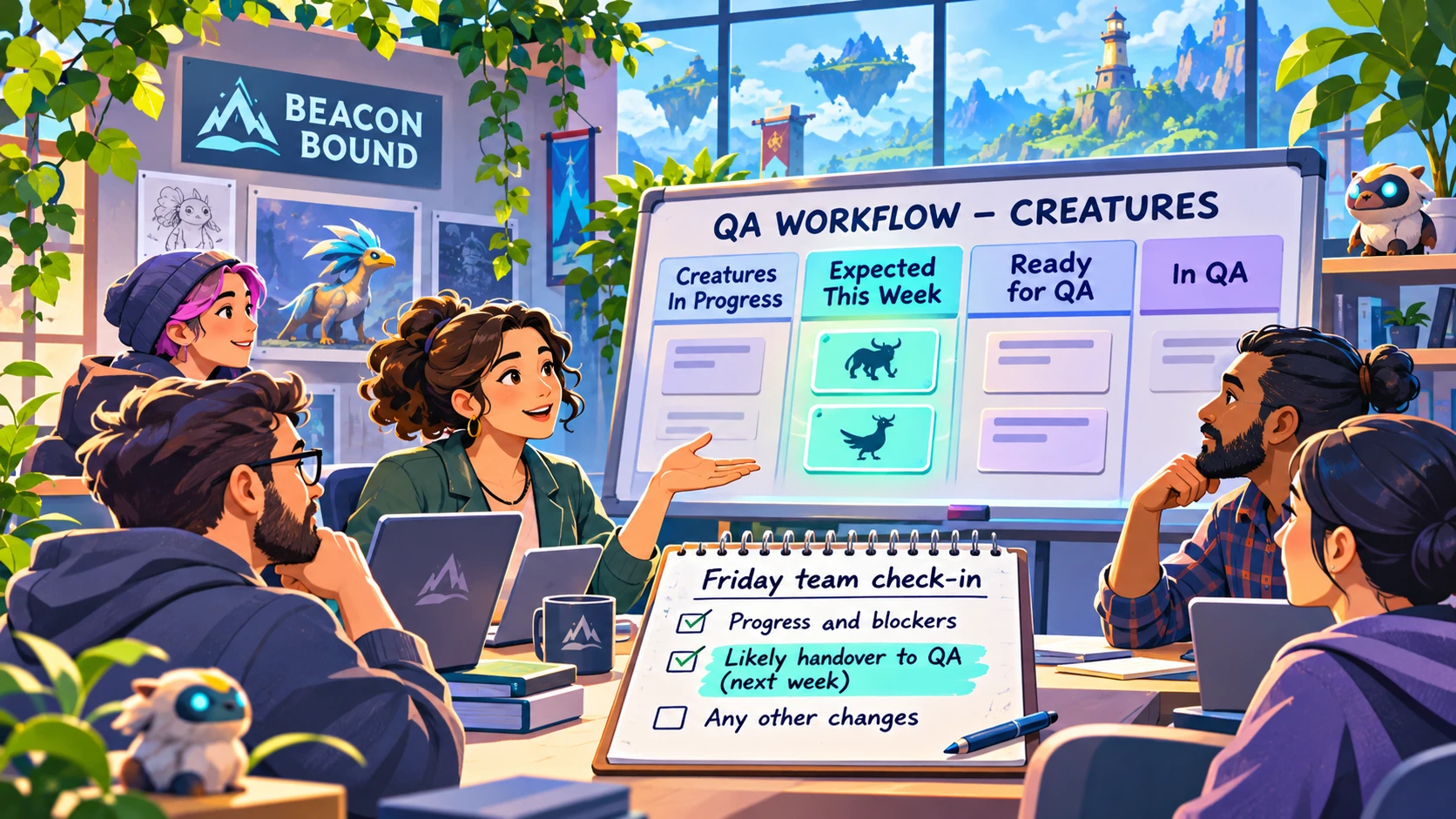
What if, at our Friday meeting, we spent a minute or two looking at the work we expect to be handing over to QA during the following week?
We might have two creatures which are approaching the end of development and which we think will be ready for testing on Thursday. Wouldn’t it be useful for the QA lead to know about those two creatures on Monday morning, when they’re looking at all the other work being asked of their team?
They can now decide whether they’ve got the capacity to make some time available on Thursday. That doesn’t mean we’ve promised to have the creatures ready on Thursday, nor does it mean that the QA lead has promised to test them on Thursday regardless of whatever else is happening in the studio.
Expected work isn’t ready work
One of the things I wouldn’t want to do is start putting cards into the Ready column on the QA board for work that isn’t actually ready for testing. We could, however, have a little area on the board showing the QA team what work the other teams think they’ll be handing over that week. When the work is actually ready, we hand it over as we did before.
We’ve now made a change to the way these two teams work together. We haven’t employed any more testers, introduced another tool or asked everyone to attend another meeting. We’ve simply agreed with the QA lead that we’re going to give them some useful information before they need to make their decisions.
How do we know whether it helped?
I would want to come back to this at one of our Friday meetings in a few weeks’ time. There are two quite different things I’d like to find out.
Firstly, did we actually do what we agreed to do? Did the QA lead have that information when they planned the week’s work? Was there any capacity available to accommodate it?
Secondly, did it make any difference to the amount of time the work was spending waiting? We have some information from the previous six weeks, so we can have a look at the dates on some comparable pieces of work since we made the change.
Perhaps the Creatures team is finding it difficult to forecast what it’ll be handing over next week. In which case, we might want to change the way we produce our forecast. Perhaps QA is able to plan for the work and the amount of time we’re spending chasing it has started to come down. Or we might discover that the change isn’t particularly useful and decide to stop doing it.
What if QA hasn’t got the capacity?
Of course, we might discover that the QA lead has got all the information they need and still can’t accommodate our work.
If you’re a producer on the Creatures team, you’re unlikely to be in a position to decide that the studio needs to employ more testers. Similarly, you shouldn’t be telling the QA lead that work on your game takes priority over work on the other game.
But you’ve got some rather useful information now. You can help the lead producer or executive producer understand what the consequences might be of changing the order of work or some of the plans for the game. If the problem concerns the capacity the studio has available across its games, that’s a conversation to have with the head of production or whoever has the authority to make those decisions in your studio.
One thing this week
I would suggest you have a think about a problem you’ve already had to deal with two or three times this month. Go and have a chat with the people involved and find out a bit more about why it keeps happening. Is there one small thing you could agree to try differently, and how would you work out whether it helped?
Our producer in the example didn’t find a spare week in which to improve production. They made some time within the work they were already doing to investigate a problem and try to improve the way two teams work together. If it helps, they might also have a bit more time on a Friday to do something else.
I’ve gone into quite a lot more detail about some of these ideas in my Kanban for Game Producers video and in my three-part series on Kanban and time management, managing work across games and working with shared specialists.
I’d be particularly interested to hear from those of you who’ve been trying to make improvements whilst making a game. What have you changed, and how did you find the time to do it?