This article is part of a short series applying ideas from my book, Risk Management for Video Game Professionals, to the commercial and leadership pressures now shaping the games industry. The book, and the related Game Production Academy courses, are built around a practical idea: risks should not remain informal until they become crises. They need to be named, assessed, owned, mitigated, tracked and communicated.
That matters when we talk about studio sales, acquisitions, minority investments and roll-ups, because these are not just financial events. They are also risk events. When a studio takes investment or sells, the public language is usually about growth, stability, support, reach and opportunity. Sometimes those claims are true. Sometimes the deal genuinely buys time, protects payroll or gives the studio access to resources it could not otherwise reach.
But the risk management question is slightly different. What risk moves when the deal is signed? Who gains protection? Who gains liquidity? Who gains control? Who carries the downside if forecasts miss, strategy changes or the wider portfolio comes under pressure? This is where the discussion needs to move beyond simple morality tales about founders selling out, and into the more useful territory of governance, deal structure, risk transfer and protection for the people left carrying the work.
1. Introduction: the deal is also a risk event
When people see studio closures and layoffs after acquisitions or investment rounds, the simple story is usually the easiest one to reach for. Founders sold out, executives took the money, and staff were left to deal with the consequences. Sometimes there is a version of truth in that, and we should not be naive about incentives. However, it is too simple to explain the pattern properly.
The more useful way to look at this is through risk transfer. A sale, minority investment, roll-up, IPO or strategic acquisition is not only a funding event. It is a moment where risk moves. Control may move. Reporting pressure may move. Strategic dependency may move. The future of the studio may become tied not only to the quality of its work, but to the capital structure around it, the forecasts used to justify the deal, the buyer’s portfolio logic and the wider market conditions that neither side fully controls.
That is why I think risk management gives us a better critique than moral outrage on its own. The question is not simply whether founders should ever sell, because of course there are rational reasons to sell. The better question is who gains certainty at the point of transaction, and who carries uncertainty afterwards.
See also in the book Chapter 17: Financial, Legal, Regulatory and Compliance Risks, for business-side risks that affect delivery. Chapter: Governance Risks and Organisational Debt, for decision rights, ownership and escalation. Risk Realities Across Studio Models, for how funding and studio structure change risk exposure. Chapter 12: Project, Programme and Portfolio, for understanding how portfolio logic can override project-level reality. |
2. The moral hazard
There is a real moral hazard in the acquisition model. At the moment of sale, founders and shareholders may realise value. Staff are often told that the deal brings stability, resources, reach and independence. Sometimes that is true for a while. A deal can preserve payroll, buy runway, fund a bigger project or give a studio access to support it could not build alone.
However, none of that guarantees what happens when forecasts slip, markets change, debt becomes more expensive, a parent company changes strategy or the portfolio needs to be simplified. A creative team can be doing good work and still be cut because the parent company needs margin, fewer bets, stronger concentration on flagship IP or a cleaner story for investors.
This is the uncomfortable part. The upside of the deal can arrive immediately for some people, while the downside may arrive later for others. That does not prove bad intent in every case, but it does create a structural problem that deserves to be discussed properly.
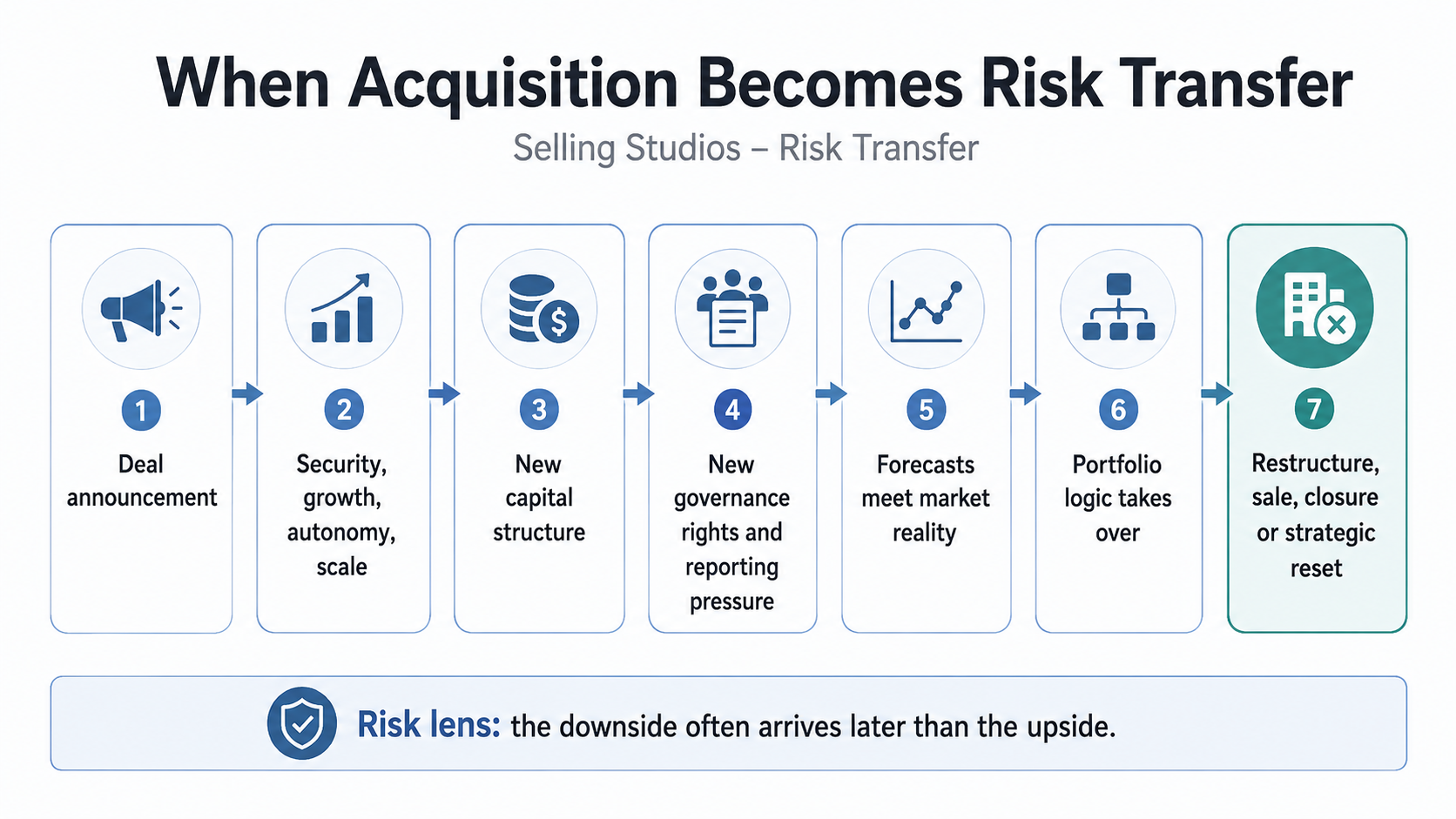
Infographic: when acquisition becomes risk transfer.
3. Minority capital is not the same as a sale
It is important to separate minority investment from full acquisition, because they are often discussed as if they are broadly the same thing. They are not. A minority investment may allow a studio to remain independent while gaining capital, expertise, distribution or strategic support. That can be extremely useful. It may be the difference between survival and collapse.
However, minority capital still changes the risk environment. The founders may retain operational control, but the studio may now carry stronger reporting obligations, investor rights, growth expectations, board scrutiny and reserved matters. The company may still be independent in legal form, but it may no longer have quite the same freedom to drift, delay or revise the story it told when the money came in.
A full acquisition changes the problem more dramatically, because control moves. From that point onwards, the studio sits inside a wider portfolio. It may retain autonomy, but that autonomy now depends on governance and parent-company strategy. The studio’s creative value can begin to compete with margin targets, debt pressure, restructuring plans, platform priorities or other projects in the group.
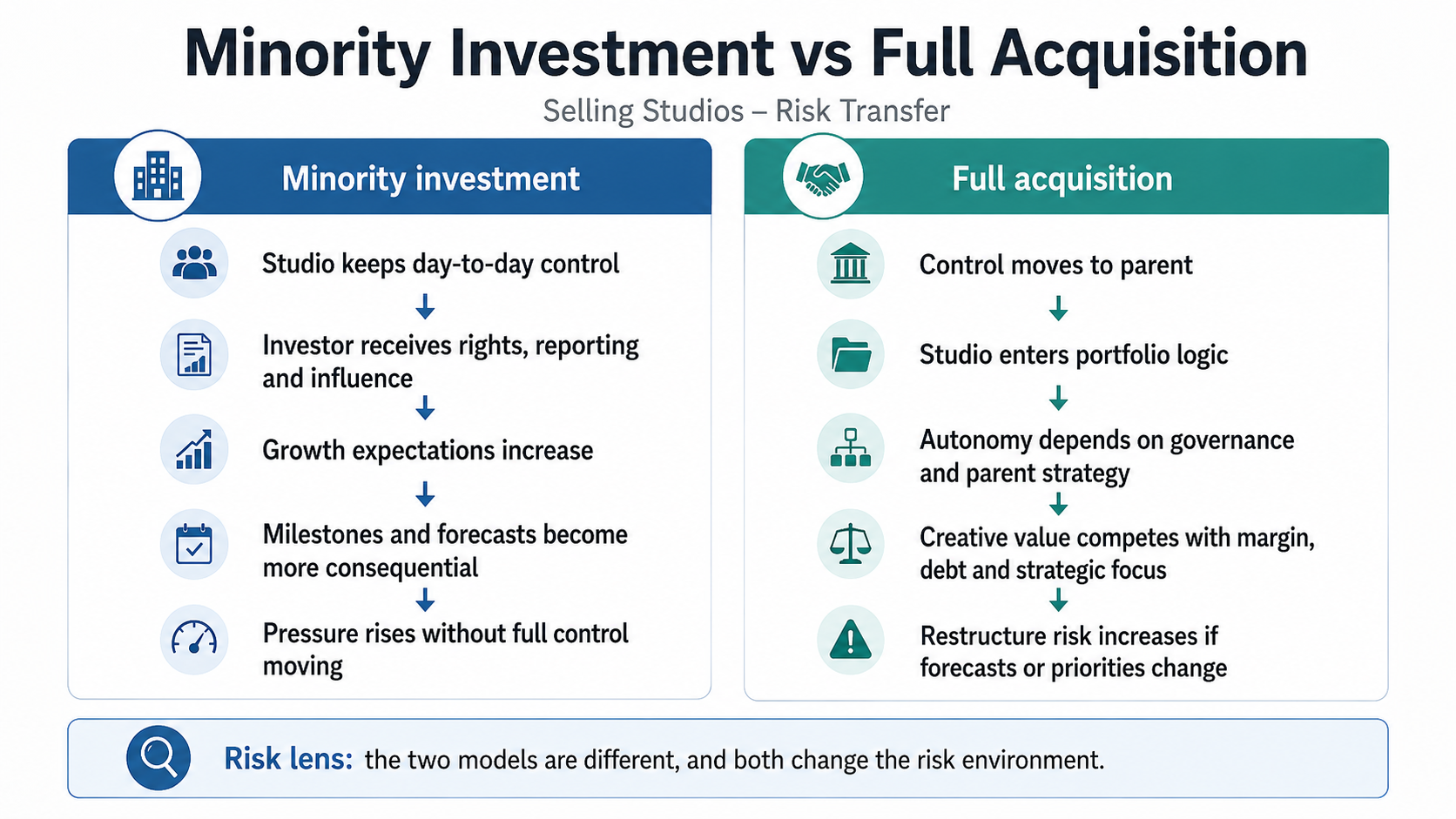
Infographic: minority investment compared with full acquisition.
4. What risks move when the deal is signed?
In the book, I describe risk management as a cycle of identifying, assessing, mitigating, implementing, monitoring and communicating. I think deals should be treated in the same way. Before signing, a studio should not only go through legal and financial due diligence. It should also run a deal risk review.
That review should not be performative. It should ask what happens to financial risk, governance risk, staffing risk, portfolio risk, cultural risk, IP risk, toolchain risk, delivery risk, communication risk and reputational risk once the transaction is complete. It should also ask who is protected if the assumptions under the deal turn out to be wrong.
Risk | If/then wording | Owner | Mitigation |
|---|---|---|---|
Autonomy risk | If autonomy is only informal, then portfolio pressure may override studio judgement. | Founder / Board. | Define autonomy period, reserved matters and decision rights. |
Staffing downside risk | If forecasts miss after shareholders realise value, then staff may absorb the later downside. | Board / People Lead. | Agree retention, severance and consultation protections. |
Strategic drift | If parent priorities change, then the studio may lose support despite strong delivery. | Studio Head. | Define strategic review gates and fallback plans. |
Integration risk | If shared services are imposed too quickly, then local delivery systems may slow or break. | Integration Lead. | Phase integration and preserve critical local workflows. |
IP/tooling risk | If the parent cancels the project, then the team may lose reusable technology or creative value. | Legal / Studio Leadership. | Negotiate reuse, licensing or buyback rights where possible. |
Forecast risk | If the deal model assumes aggressive growth, then later correction may require layoffs or closure. | CFO / Portfolio Lead. | Use staged hiring, milestone confidence reviews and downside scenarios. |
The point here is not that every mitigation will be accepted. Some buyers will resist these protections. Some founders may not have the leverage to secure them. But at least the conversation becomes explicit. That matters, because vague promises are not mitigations. Governance mechanisms, written terms, review gates and agreed fallback plans are much closer to mitigations.
5. Questions founders should ask
Founders thinking about a deal usually ask whether the valuation is good, whether the buyer is credible, whether the studio will have more resources and whether the transaction helps the game or the company reach the next stage. Those are legitimate questions. I would add a harder set underneath them.
Question | Why it matters |
|---|---|
What is the buyer really buying: IP, team, technology, market access, revenue, optionality or credibility? | It clarifies what must be protected after the deal. |
What assumptions justify the valuation? | It exposes the forecast fragility inside the transaction. |
What happens if those assumptions fail? | It tests whether downside planning exists. |
Who can change the studio strategy after close? | It identifies control risk. |
What decision rights remain local? | It protects operating autonomy. |
What protections apply to staff if the parent changes direction? | It tests whether the language of security is real. |
Can the studio survive in another form if the deal fails? | It creates alternatives before closure becomes the only visible option. |
These questions are uncomfortable, and that is partly why they are useful. They force leaders to look beyond the celebration of the transaction and into the period where the consequences actually unfold.
6. Questions employees should be able to ask
Employees rarely have access to the full deal terms, and that makes this difficult. However, they can still ask practical questions, and leadership should be prepared to answer them honestly within the limits of what can be shared.
What changes immediately?
Who now owns strategic decisions?
Will reporting lines change?
Are there committed investment periods?
What is the integration plan?
What happens to current projects?
Will tools, pipelines or workflows change?
How often will leadership update staff on deal commitments?
What protections exist if the strategy changes?
If leadership cannot answer these questions at all, that is a signal. It may not mean the deal is bad, but it does mean the organisation has communication and governance risk before the new structure has even started to operate.
7. Communication after the deal
One of the common failures after a transaction is that communication stays trapped in announcement mode. Everything is described as opportunity. Very little is described as uncertainty. I understand why that happens. Leaders want to reassure people, and nobody wants to celebrate a deal by listing everything that might go wrong. However, if the only message is optimism, trust becomes very fragile later.
Good risk communication is not pessimism. It is a way of treating staff like adults. If the deal brings opportunity but also integration risk, reporting changes, market pressure or portfolio exposure, then say so in a controlled and useful way. People do not need every confidential detail, but they do need a truthful frame for what may change.
Communication item | Purpose |
|---|---|
Initial deal explanation. | Explain why the deal happened and what changes now. |
Decision-rights summary. | Clarify who owns what after the transaction. |
Integration risk update. | Make operational changes visible. |
Milestone confidence review. | Show whether the plan still holds. |
Staff protection update. | Revisit commitments made at announcement. |
Portfolio context update. | Explain parent-company changes that affect the studio. |
8. Closing thought
The strongest critique of studio selling is not that all sales are wrong. They are not. Some sales are rational, necessary and even protective. The stronger critique is that too many deals realise value for some participants before the hardest risks are understood or protected for the people who remain.
This is why I think the industry needs better deal literacy, not just among lawyers and investors, but among studio heads, production leaders, employee representatives and senior creatives. A sale should be treated as a risk-transfer event and managed with the same discipline we would expect for major technical, financial, operational or reputational risks.
If leaders genuinely mean that a deal will protect the team, then that promise needs to exist somewhere more durable than the announcement post. It needs to appear in governance, decision rights, communication rhythms, staffing protections, integration planning and downside options. Otherwise, independence becomes branding, and restructuring becomes the bill that arrives after the celebration.
This is the kind of issue I wanted Risk Management for Video Game Professionals to help studios think about more clearly. Risk management is not only about bugs, schedules and delivery. It is also about governance, ownership, communication, financial exposure, staffing fragility and the consequences of decisions made far above the project team.
The Game Production Academy courses take the same practical approach: identify the risk, assess it honestly, decide what can be done, assign ownership, track the action and communicate clearly as the situation changes. Applied to studio sales and investment, that means asking better questions before the deal is signed, not only after the consequences arrive.