This article is part of a short series applying ideas from my book, Risk Management for Video Game Professionals, to some of the larger structural problems now facing the games industry. The book, and the related Game Production Academy training, are both concerned with a practical question: how do we make risk visible early enough for studios, leaders and teams to do something useful about it?
In this piece, I want to look at scale. Not because scale is automatically bad, or because small studios are automatically better, but because games companies often scale different kinds of work without properly separating the risks involved. Publishing, localisation, QA, compliance and platform operations may benefit from scale. Creative direction, trust, taste, team culture and hit creation behave very differently.
So rather than treat consolidation as a simple story of growth or decline, I want to apply a risk management lens to it. What is being scaled? What assumptions are being made? Which risks move from project level to programme level, and from programme level to portfolio level? And what should leaders be looking for before the supposed benefits of scale become another source of fragility?
1. Introduction: why scale becomes a risk question
The games industry keeps returning to the question of scale, usually at the point where money is entering the system, or leaving it. Studios are acquired, groups are consolidated, publishers centralise functions, platforms expand their ecosystems, and suddenly we start to hear the familiar language of efficiency, focus, shared services, leverage and portfolio discipline.
I do not think that scale is automatically wrong. That would be far too simplistic. There are many parts of games where scale is helpful and, in some cases, essential. A larger group may be able to provide better platform relationships, stronger legal and compliance support, localisation pipelines, QA coverage, finance, user acquisition, analytics, backend infrastructure and a level of commercial protection that a smaller studio could never build alone.
However, the problem begins when we assume that because these functions scale, the creative core of game development also scales in the same way. That is where many of the mistakes begin. It is also where risk management becomes useful, because it gives us a way to separate the parts of the business that genuinely benefit from scale from the parts that may be damaged by the attempt to standardise or optimise them.
In the book, I spend a lot of time arguing that risk management is not a paperwork exercise. It is a way of making uncertainty visible early enough that teams and leaders can make better decisions. Scale is full of uncertainty. The question is whether the organisation is honest enough to name it.
See also in the book Chapter 4: Risk Landscape, for the wider market pressures behind consolidation and retrenchment. Chapter 12: Project, Programme and Portfolio, for understanding how risk changes as the organisational lens widens. Risk Realities Across Studio Models, for the different ways scale, funding and structure change exposure to risk. |
2. The category error
A games company can be described in several different ways depending on the person doing the describing. To a buyer, it may look like people, IP, pipeline, forecasts and brand. To a founder, it may look like years of relationships, decisions, mistakes, instincts, shared habits and trusted leadership. Both views contain truth, but they are not the same truth.
This is one of the reasons I think acquisitions and consolidation in games can become so fragile. The financial model may describe the studio as an asset, but the thing that makes the studio valuable is often a set of relationships and behaviours that do not sit neatly in the model. You can own the shares, the name, the codebase and the IP, but that does not mean you own the trust that allowed the studio to produce good work.
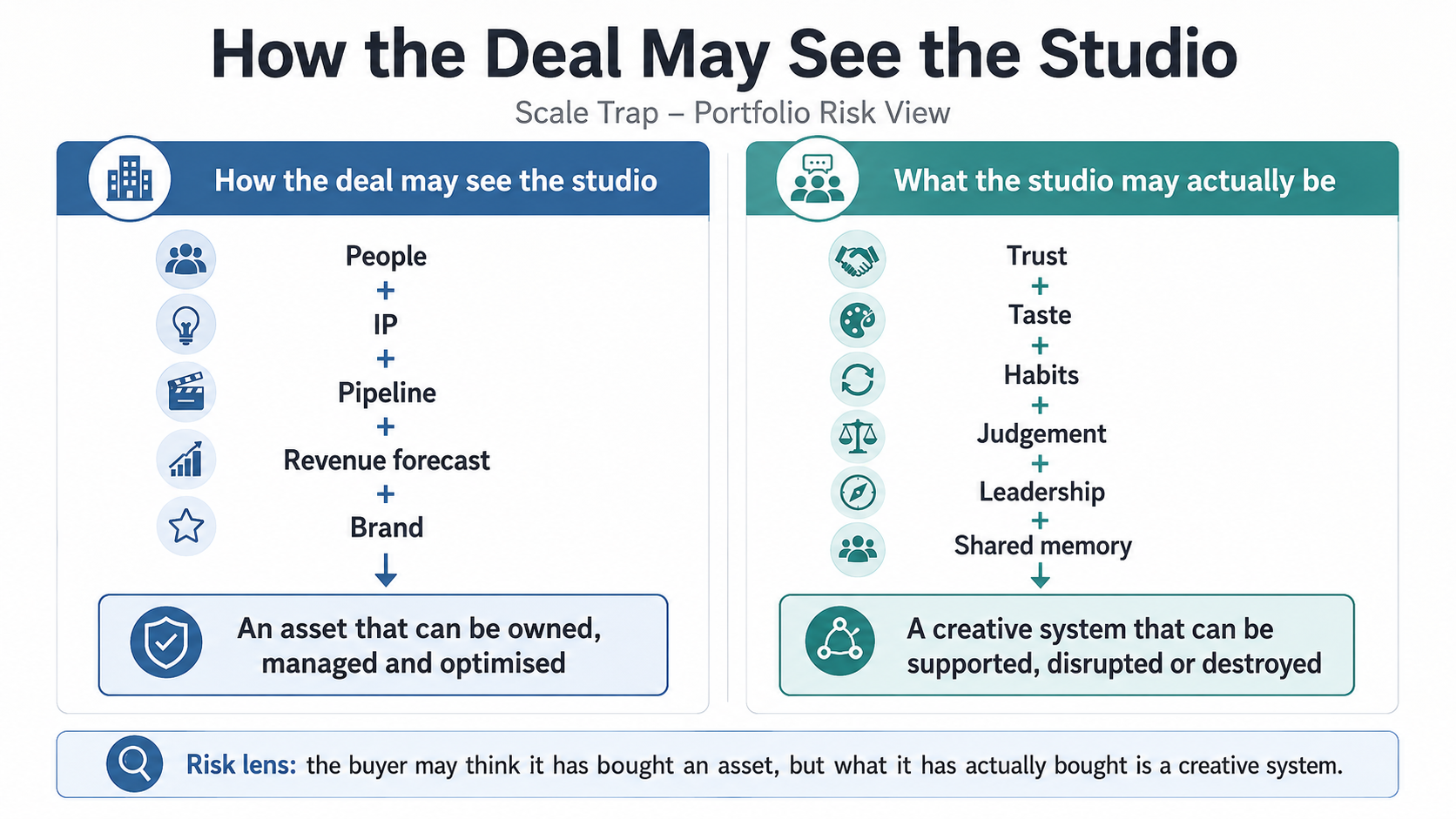
Infographic: how a deal may see the studio compared with what the studio may actually be.
This is where the risk-management lens helps. Instead of asking only whether a studio can scale, we should ask what is being scaled, what is being protected, and what might be accidentally weakened by the structure being imposed. In practical terms, I would want any acquisition, integration or centralisation plan to answer questions such as these:
What exactly are we scaling?
Which parts of the studio are operationally repeatable, and which depend on taste, judgement and trust?
Which risks move from project level into programme or portfolio level?
What decision rights change after the transaction or restructure?
What must not be standardised if we want to preserve the studio’s value?
What evidence would tell us that the scale thesis is not working?
3. Where scale genuinely helps
It is worth being fair here. There are real economies of scale in games. I have no interest in pretending otherwise. Shared platform knowledge can prevent painful submission mistakes. Stronger compliance support can stop legal and regional problems becoming launch blockers. A bigger QA organisation can give you better device coverage, more structured test plans and more mature reporting. Analytics and user acquisition can benefit from scale, particularly in mobile and live service environments.
This is why the argument should not be reduced to big company bad, small studio good. Many small studios are fragile in ways that larger organisations can help with. Many independents would benefit from better legal, finance, QA, production, people and commercial support. The risk is not the existence of scale, but the assumption that all types of work benefit from it in the same way.
A larger group can scale the edge of game production more easily than it can scale the centre. It can provide better support around the game. It cannot reliably manufacture the creative judgement that makes the game matter. That is the distinction I would want leaders and investors to sit with for longer than they usually do.
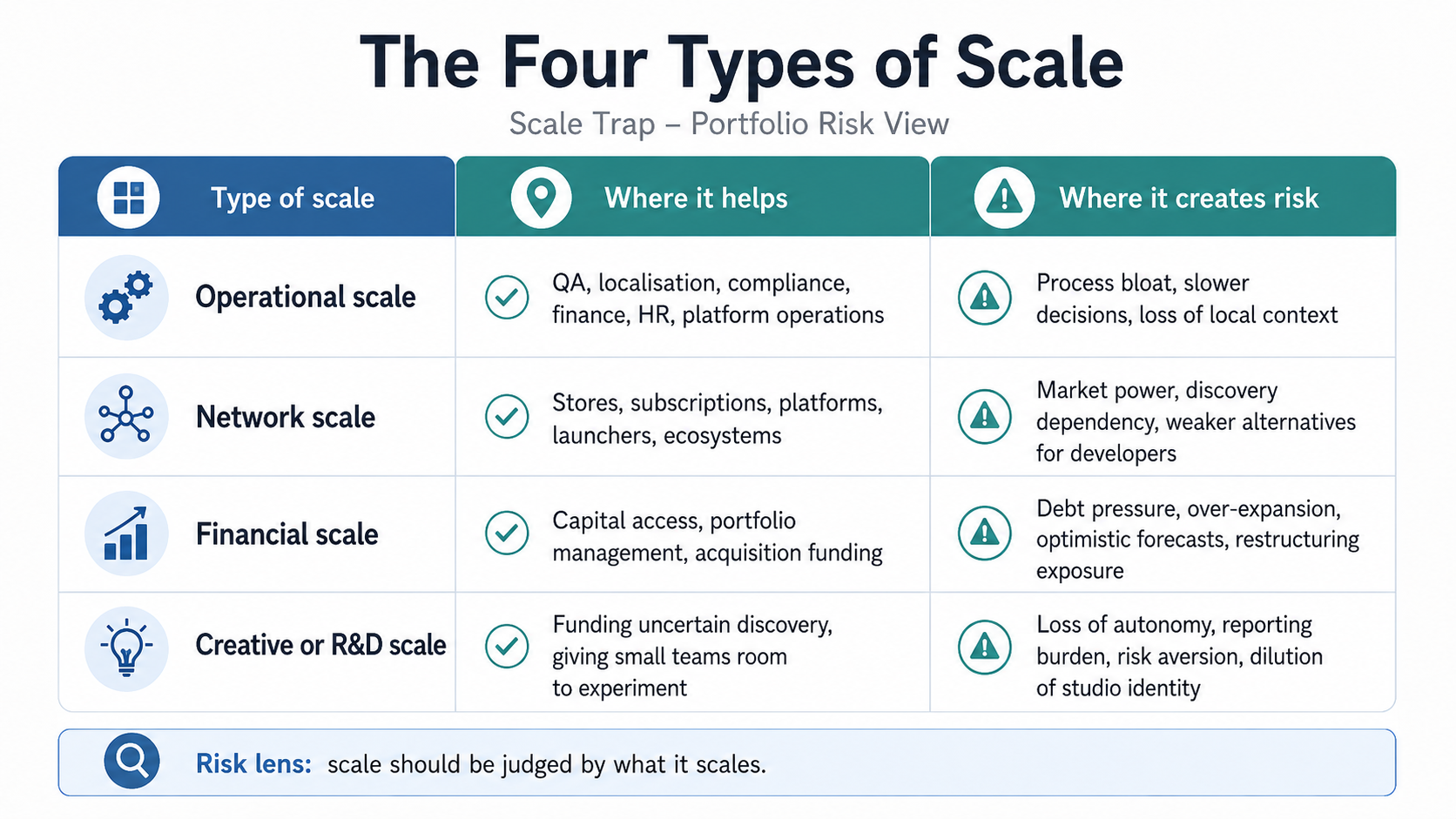
Infographic: the four types of scale and where each creates risk.
4. The four types of scale
When I look at scale through a risk lens, I find it useful to separate at least four different types. They are often bundled together in strategy conversations, which is part of the problem. If we do not separate them, we end up with a vague belief that scale is either good or bad, rather than a more useful discussion about what kind of scale we are actually attempting.
Each type needs different controls. Operational scale needs clear service expectations, escalation paths and feedback from the teams using the services. Financial scale needs assumption testing, staged commitments and proper downside planning. Creative scale needs a serious conversation about autonomy, review gates, leadership trust and how much uncertainty the organisation is genuinely willing to carry.
5. Applying the project, programme and portfolio lens
In the book, I describe project, programme and portfolio risk as three overlapping conversations. This is especially useful when thinking about scale, because the people feeling the risk are not always the same people creating it.
Lens | Scale risk question | Typical signal |
|---|---|---|
Project | Can the team still deliver the game under the new constraints? | Scope churn, morale damage, tool friction, blocked decisions. |
Programme | Are shared services, tools and dependencies improving or slowing delivery? | Cross-team blockers, duplicated work, integration delays, unclear ownership. |
Portfolio | Does the investment thesis still hold across the wider group? | Forecast misses, project cancellations, studio divestments, centralised cost reduction. |
The danger is that each level can look at the problem from its own limited angle. At project level, people may be dealing with slower decisions, unclear approvals or tooling friction. At programme level, people may be trying to coordinate dependencies between studios that do not work in the same way. At portfolio level, leaders may be looking at margin, forecast, debt, strategic focus or investor confidence. All of these conversations are valid, but they become dangerous when they are not connected.
This is why risk reporting has to move upwards and downwards. Teams need a way to escalate what is actually happening on the ground. Leadership needs to communicate changes in portfolio assumptions, not simply announce decisions after the fact. Otherwise, the organisation may look more mature while becoming less able to see what is happening inside its own projects.
6. A practical scale risk assessment
If I were helping a studio or group assess a scale decision, I would not begin with a grand strategy document. I would begin with a small number of practical questions and force the leadership team to answer them properly. It is the kind of exercise that can look deceptively simple until people realise how many assumptions are sitting underneath the plan.
Question | Risk being tested | Evidence required |
|---|---|---|
What are we scaling? | Confusion between operational, financial and creative scale. | Written scale thesis. |
What must not be standardised? | Loss of the creative conditions that made the studio valuable. | Studio autonomy map. |
Which dependencies increase? | Programme-level coordination failure. | Dependency map. |
What decision rights change? | Governance drift. | Decision-rights table. |
What forecast assumptions are critical? | Portfolio overconfidence. | Assumption log. |
What happens if the forecast is wrong? | Late restructuring as the only visible mitigation. | Downside scenario plan. |
Who owns intervention? | Ownership vacuum. | Named accountable owner. |
What options exist before layoffs or closure? | Blunt mitigation. | Alternative action plan. |
This is not intended to make the process heavier. In my experience, the opposite is usually true. Good risk work reduces wasted discussion because it forces people to name what they are worried about, who owns it and what would cause action to be taken.
7. Closing thought
The scale trap is not that games companies grow. The scale trap is believing that ownership, capital and shared process can make creative success predictable. They can support the work, and sometimes they can protect it. They can also suffocate it if the organisation forgets what actually creates value inside a studio.
The better question is not whether games should reject scale. That is not realistic and, in many cases, not desirable. The better question is whether leaders can design scale in a way that protects the creative systems they are trying to support. That is a risk-management question, and it should be asked long before the first integration plan, acquisition announcement or restructuring memo appears.
If you are interested in this way of thinking, this is the kind of practical risk lens I explore in Risk Management for Video Game Professionals and through the Game Production Academy courses. The purpose is not to turn game development into paperwork, or to drain the creative life out of studios. It is to give producers, leaders and teams a clearer way to see what is really happening before scale, ambition or investment quietly become new sources of fragility.
The more complex the industry becomes, the more we need risk management that understands the reality of making games. Not generic corporate process, but practical tools for project, programme and portfolio decision-making in a creative environment.