This article is part of a short series applying ideas from my book, Risk Management for Video Game Professionals, to current problems in the games industry. Much of the book focuses on the practical foundations of risk management: identifying risks, assessing them, deciding what to do about them, tracking the actions, reviewing what changes and communicating the right information to the right people.
However, none of that works properly if leadership cannot translate between the different worlds inside a studio or games business. Game development sits between craft and capital, creativity and governance, team reality and investor expectation. If leaders only understand one side of that equation, they may still make confident decisions, but those decisions can carry risks they do not fully understand.
In this piece, I want to look at leadership translation as a governance risk. This is not about blaming games-native leaders or external corporate leaders. Both can be valuable. The problem appears when either group mistakes partial fluency for full understanding. Risk management gives us a way to make that gap visible before it becomes over-expansion, loss of trust, bad forecasting, late cuts or another round of decisions explained afterwards as discipline.
1. Introduction: the missing translation layer
The games industry does not only have an investment problem. It also has a leadership translation problem. This is not about saying that games people are naive or that corporate people are villains. I think that is too easy, and it does not help us very much. The issue is that games requires leaders who can understand two very different worlds at the same time.
On one side, there is the world of craft: teams, taste, production pain, creative uncertainty, player expectation, iteration, morale and the strange emotional reality of making something that might not work until quite late. On the other side, there is the world of capital: governance, forecasting, runway, investor confidence, portfolio discipline, shareholder pressure, deal structure and the need to make decisions before all the information is available.
The trouble begins when a leader is fluent in only one of those languages. They may be excellent in their original domain and still make poor decisions because the problem in front of them requires both. This is why I think risk management is such a useful bridge. It gives us a structured way to translate uncertainty into decisions without pretending that the uncertainty has disappeared.
See also in the book Governance Risks and Organisational Debt, for decision ownership, escalation and organisational debt. Chapter 10: Fostering a Proactive Risk Culture, for how teams surface risk without fear. Chapter 19: Strategic Risks, for drift, leadership changes and strategy that becomes disconnected from delivery. Chapter 24: Agile, Lean and Kanban Risk Management, for the point that delivery models do not replace risk management. |
2. Two incomplete leadership models
The first incomplete model is the games-native founder or studio leader. This person may understand development deeply. They may have lived through the chaos of production, fought for teams, protected the work and built a studio through taste, persistence and relationships. That experience is valuable and should not be dismissed.
However, that does not automatically make someone good at running a capitalised business. A founder can be brilliant at making games and still poor at financial control. They can understand production pain and still overpromise to investors. They can love the team and still fail to confront reality early enough. They can believe in the game so deeply that optimism becomes a kind of avoidance.
The second incomplete model is the external executive or corporate operator. This person may understand scale, capital, governance, shareholder expectations and portfolio strategy. They may be very good at running large organisations. Again, this is valuable. Games does need business discipline, and it is unhelpful to pretend otherwise.
However, that does not automatically make someone a good steward of creative work.
A corporate leader can read a forecast and still misunderstand the uncertainty inside it. They can see a studio as an asset without understanding the relationships that make it productive. They can impose discipline and accidentally remove the conditions required for originality.
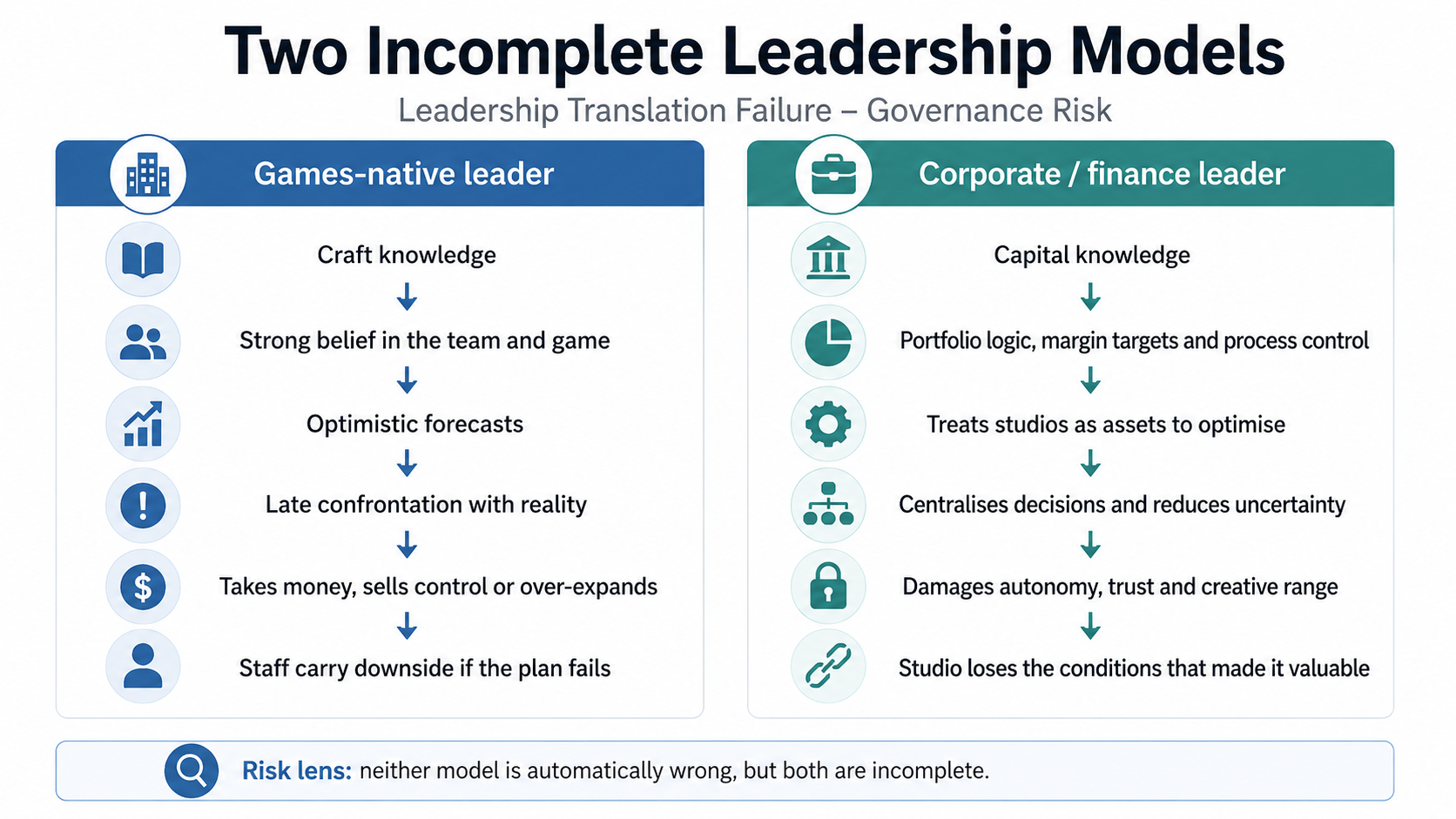
Infographic: two incomplete leadership models.
3. Why this is a governance risk
In the governance chapter of the book, I describe governance risk as the risk that emerges when decision-making lacks visibility, consistency or ownership. That may sound formal, but the practical version is very simple: people do not know who owns the decision, how to escalate a concern, whether something was approved or merely assumed, or where the record of a decision lives.
This is exactly where leadership translation failures become dangerous. If leadership does not understand production uncertainty, it may ask for more reporting instead of better evidence. If production teams do not understand capital pressure, they may experience governance as interference rather than as a way of protecting the project. Everyone then starts using the same words differently. Confidence, readiness, risk, progress, milestone and scope all begin to mean different things depending on who is speaking.
That is how organisational debt builds. Decisions happen in private conversations. Approval is inferred from silence. Risks are softened as they travel upwards. Producers become translators without the authority to resolve the thing they are translating. Teams continue building against assumptions that are no longer true. By the time the risk is finally visible, it has usually become an issue.
When this happens, the failure is often described as poor delivery. Sometimes it is. But in many cases, the delivery failure was enabled by weak governance long before the milestone was missed.
4. The control spiral
A common response to uncertainty is control. That is understandable. When leaders feel they cannot see what is happening, they ask for more reports, more reviews, more sign-offs, more process and tighter forecasts. Some of that may be necessary, particularly in larger organisations. The danger is that control can make the information worse if teams begin to feel that bad news will be punished, ignored or interpreted as incompetence.
I have seen versions of this many times. The team knows there is a problem, but the message is softened. The dashboard stays amber when it should be red. The milestone is described as challenging but achievable, which can mean almost anything. Leadership then receives a filtered picture, responds with more control, and the next round of reporting becomes even less honest. That is the spiral.
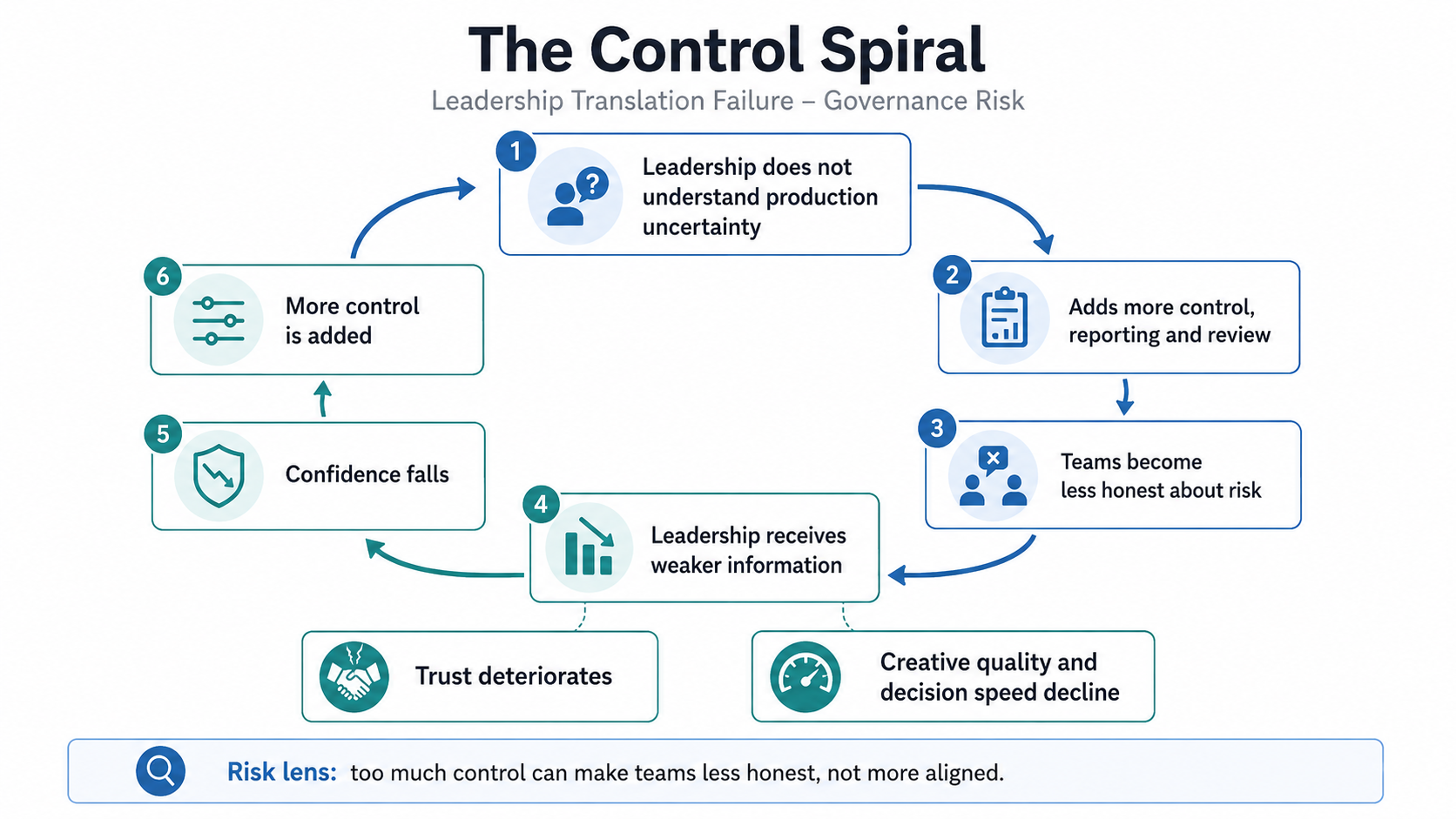
Infographic: the control spiral.
This is why risk culture matters. A good risk culture is not one where everyone is cheerful, nor is it one where everyone fills in a form. A good risk culture is one where people can raise uncertainty early and expect the organisation to do something useful with it. If raising a risk simply creates blame, extra meetings or political discomfort, people will stop raising risks. They will continue to know things, but the organisation will not know them officially.
5. What better leadership translation looks like
A better leadership model does not require every finance leader to become a game designer, or every creative leader to become a corporate finance expert. That is not realistic. What it does require is a shared language for uncertainty and a leadership cadence that forces the right conversations to happen before the only remaining options are cancellation, closure or a desperate reset.
In practice, I would expect a leadership team to ask questions such as:
What uncertainty are we currently carrying?
Which risks are known informally but not owned formally?
What evidence supports the current forecast?
What would change our view?
Who is allowed to escalate bad news?
Which decisions are stuck, implied or drifting?
What options exist before cancellation, layoffs or closure?
These are not soft questions. They are decision-quality questions. They help leadership distinguish between a team that is genuinely on track and a team that is maintaining the appearance of being on track because the organisation has not created a safe or useful way to say otherwise.
6. Leadership translation diagnostic
Here is a practical diagnostic I would use with a studio leadership team. The point is not to catch people out. The point is to reveal whether the organisation has a working translation layer between production reality and leadership decision-making.
Question | Healthy answer | Risk signal |
|---|---|---|
What is the biggest uncertainty in the project or studio? | Leaders can name it clearly and consistently. | Leaders speak only in general confidence language. |
Who owns the decision if the risk worsens? | A named person or group is accountable. | Ownership is distributed, vague or political. |
Where is the decision recorded? | A decision log, risk register, board pack or project tool. | It lives in memory, Slack or private conversations. |
What evidence would change the plan? | Defined triggers, thresholds or review gates exist. | The plan changes only after crisis. |
Can staff escalate without punishment? | Escalation is treated as contribution. | Bad news is softened, delayed or punished. |
Do creative and financial leaders review the same risk picture? | There is a shared dashboard or review cadence. | Finance sees numbers while teams see reality. |
7. Decision logs and risk registers
I think one of the most useful ways to improve leadership translation is also one of the least glamorous: write down the important decisions. Not everything, of course. Nobody needs a giant decision cemetery. But when a decision changes scope, funding, delivery, staffing, market positioning or autonomy, it should be recorded in a way that allows people to understand what was decided and why.
Decision | Rationale | Risk considered | Owner | Review trigger |
|---|---|---|---|---|
Delay feature X to post-launch. | Protect launch stability. | Player backlash, marketing mismatch, dependency impact. | Executive Producer. | If retention or marketing risk increases. |
Keep team Y autonomous during integration. | Preserve creative velocity. | Loss of trust, process friction, cultural disruption. | Studio Head. | If delivery visibility drops or duplication increases. |
Reduce scope before increasing headcount. | Avoid fixed-cost risk. | Schedule pressure, morale risk, reduced feature ambition. | Production Director. | If milestone confidence falls below agreed threshold. |
This is not about creating more bureaucracy. It is about stopping decisions from becoming folklore. Folklore is dangerous in game development because projects move quickly, people join and leave, and the reason something was done can disappear long before the impact of that decision has finished unfolding.
8. Closing thought
The games industry is too creative to be managed only through capital logic, and too capital-intensive to be managed only through creative instinct. That is why the translation problem matters. Studios need leaders who can understand craft without ignoring financial reality, and understand financial reality without damaging the creative system that produces the value.
Risk management will not magically create those leaders. However, it does give leadership teams a practical language for uncertainty, ownership, evidence, escalation and mitigation. That is a good place to start, and it is far better than waiting until the only remaining language is cuts, resets and regret.
This is one of the reasons I wrote Risk Management for Video Game Professionals and built the related Game Production Academy training. I do not think the industry needs more abstract leadership language. It needs practical ways for leaders, producers, discipline heads and teams to surface uncertainty, talk about it properly, assign ownership and make better decisions before the situation collapses into crisis management.
Risk management will not make hard decisions disappear. It will not remove uncertainty from creative work. But it can help leaders understand what kind of uncertainty they are dealing with, who is carrying it, and what choices still exist before the only remaining options are cuts, cancellations or public apologies.